Branding Cornerstone #1: Positioning
This crash course will help you quickly understand what brand positioning is, how it can help you grow your company, and how to do it well while you’re trying to get from 0 to 1.
Positioning your Seed-stage Company
What is Positioning?
Positioning is the process of:
- defining what your product is to your best-fit or target customer
- articulating the distinctive value these customers derive from using your product
Highlights of positioning:
- Positioning is how you are perceived in the mind of the customer.
- Good positioning answers the question: Why are you the right solution for a particular set of customers?
- Articulating the right brand positioning enables you to build a brand that’s consistent and scalable.
Why should early stage companies care about positioning?
1) Consistent positioning enables you to reach, recruit, and retain customers. If you are talking to current or prospective customers, what you say should be intentional and consistent. Messaging matters. Alienating potential customers with incorrect, inadequate, or absent positioning in the early days is much riskier in markets with a finite pool of users (this applies to almost all B2B companies and many consumer offerings) because you can churn through your potential customer base before you even establish product-market fit.
2) Clear positioning is the critical foundation for all branding work. Single-product companies attempting to establish product-market fit need to be more nimble and agile in their brand-building than companies that have already gone to market. Likewise, nascent teams who don’t yet have a marketing function or robust marketing budgets must build lean brands that evolve alongside the product and company. A clearly articulated positioning gives you the foundation to sell your product, and it also gives you the brand foundation you need to BUILD your product, organization, and company.
3) Positioning streamlines decision-making. Taking the time to articulate your positioning helps establish a framework for future decision-making about who you are and who are you for. It helps inform many strategic decisions – including company strategy as well as your product roadmap. It helps you figure out the right metrics to care about instead of chasing what’s most easily measured. Founders who take the time to do this work early give themselves a competitive edge in hiring, fundraising, go-to-market, and culture-building.
Positioning Examples
Mac & Cheese
It’s sometimes easier to understand positioning when looking at consumer products. For most, it’s more relatable. And what’s more relatable than mac and cheese? Have you ever walked the mac and cheese aisle at the grocery store? There are countless brands vying for customers’ attention and dollars. But they have all proven to be big businesses. How is this possible? The answer – they all have unique positioning.
Consider 6 popular brands of mac & cheese:

They are all similar products, but they have totally different positioning. Each product is targeted toward a specific best-fit customer. Maybe you’re even one yourself. It’s easy to imagine which mac and cheese the suburban mom on a budget would choose, or which the guy who just left the gym and is looking for a protein-filled meal would choose.
All of these brands have clearly defined what their product is to their target customer.
Lyft vs Uber
Let’s consider another consumer example, this time from the tech world. Think back to the early days of ridesharing (circa 2011/ 2012). Two companies were starting to emerge:
- They existed in the same market category (car service). In the same city (SF).
- They had a very similar product – a ride in a car that wasn’t your own.
- They delivered similar value – an easy, convenient way to get around the city.
- The key difference – each company’s unique product features:
- Uber’s supply side consisted of professional drivers in their off-hours with typical “limo” black cars.
- Lyft’s supply side was made of lay people – people like you and me – with pretty standard cars.
These product differences helped each company narrow in on their “best-fit” customer:
Uber’s best-fit customers were the tech elite who wanted to achieve a certain status and be driven around in a sweet car while being treated like well, they were elite. They wanted to keep things professional – which meant minimizing conversation, sitting in the back seat, having doors opened for them, etc.
Lyft’s best-fit customers were tech workers, creatives, and other high-income individuals who were more interested in the utility and social aspect of the service – getting from point A to B. These customers were happy to have a conversation with their driver and even sit within inches of them – in the front seat and fist bump on the way in and out of the car.

Positioning Wisdom
For most early-stage B2B companies, your product = your brand. If you are a single-product company still attempting to establish product-market fit, most available advice on positioning isn’t likely to be relevant to you at this stage. Don’t try to make later-stage or consumer positioning advice fit where you are right now. Keep it simple.
Positioning is about your customer, not you! It exists in the minds of your prospects, in the context of their existing experiences and expectations. This is why understanding your customer is the key to unlocking great positioning.
Minimum Viable Positioning. This Cornerstone offers an intentionally lightweight method of getting at your core positioning so you can land on something that can be tested as you talk to customers. It’s meant for busy founders to establish a baseline of adequate positioning that can be iterated on in the future. Your positioning will evolve as your product and company evolve.
Good positioning can’t be prescribed; it has to be nurtured. As a founder, you are in a position to know more about your customers and the problem you are solving than anyone else. You already have the answers – or access to the answers – that are necessary to construct a positioning framework than can anchor your brand and propel your company. Smart questions and targeted generative exercises can help surface those answers.
Minimum Viable Positioning Framework
Think of this as an internal asset that keeps you organized as you articulate and iterate your company’s positioning. It includes five components:
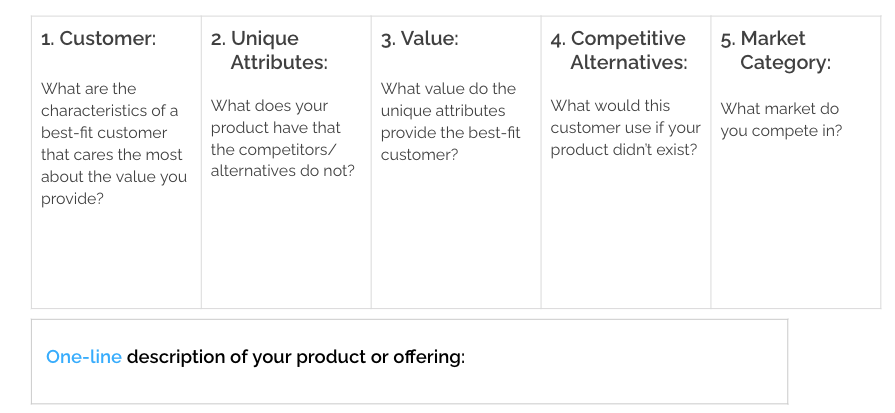
A note about your one-liner.
An effective one-liner of your company’s position includes each of the above components. This statement isn’t meant to be a cute or catchy marketing tagline, but a clear articulation of your company’s position.
It’s a valuable, workhorse piece of communication that every brand should have, as early as possible. To create your one-liner, you’ll need a working answer* to the above questions.
*Working answer just means an answer that is true for now. These answers will change as you learn more about you customer, product, and landscape. As these answers change, your positioning one-liner will evolve, too.
The next section includes generative exercises that will surface the information, language, and concepts necessary to complete your own Minimum Viable Positioning framework.
Positioning Exercises
We suggest gathering your full team for a workshop to complete the following exercises in a half-day workshop.
Exercise 1: Identify your best-fit customer. Your best-fit customer is the customer with the highest potential LTV for your specific product. These customers:
- will derive significant value from your product.
- will be positively changed by the addition of your product to their lives.
- will purchase your product repeatedly, recommend it, and/or be sad if it suddenly disappeared.
- will understand it.
- will have a strong need for it.
- will have the authority to purchase it or advocate for its purchase.
To identify your best-fit customer: Ask yourself which current or potential customers meet all of the above criteria. Spend 1-2 minutes making a list of these customers. You’ll likely start to see patterns emerge. If you’re very early and haven’t yet spoken to many customers, it’s okay to keep this list a bit looser.
Develop a best-fit customer snapshot. Using the customers on your above list as reference, spend 15 minutes creating a simple, paragraph-style description of your best-fit customer. Make sure your profile includes each element below.
- Firmographic profile
- Demographic and behavioral characteristics of the human
- The problem they are trying to solve
- How they currently solve this problem (in the absence of your solution)
- Their unmet need
- Their values
Taskrabbit example: Overwhelmed working mom between 30-45 y/o with a HHI of $200K or above who lives in a major metro. She is looking for a trusted solution to help her with household tasks so she can spend more time on the things she values, like spending time with family and excelling at work.
Exercise #2: Brand Ladder
Starting from the bottom up, answer each question. Keep your best-fit customer in mind throughout this exercise. This is a great exercise to do with your full team, especially those of you who are on the front-lines with the customers themselves.
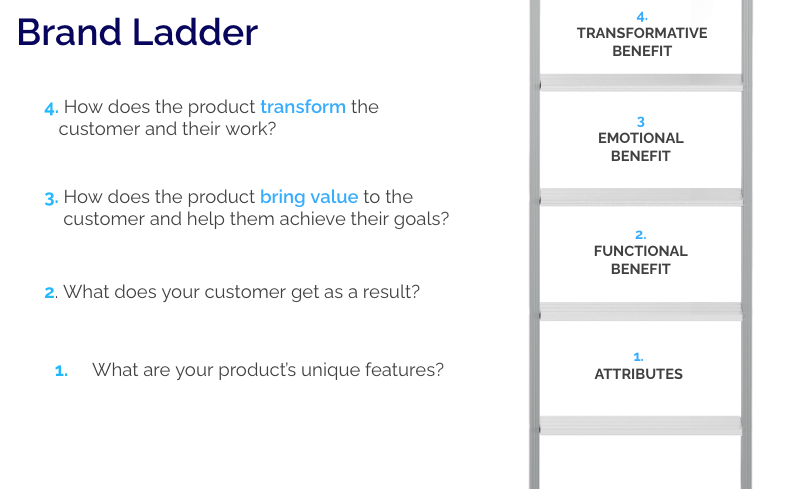
Try to take off your product-building hat for this one and really put yourself in the shoes of the customer. For example, the unique features of your product may not be technical at all – excellent customer support, a relevant partnership, or your manufacturing practices are all attributes that might differentiate you.
This is a generative exercise. The point is to surface a bunch of information, concepts, and words to use as an input in developing your positioning framework.
Exercise #3: Positioning Mad Libs
Imagine how a best-fit customer could describe your product to another potential best-fit customers. How would you want them to complete the below statements?
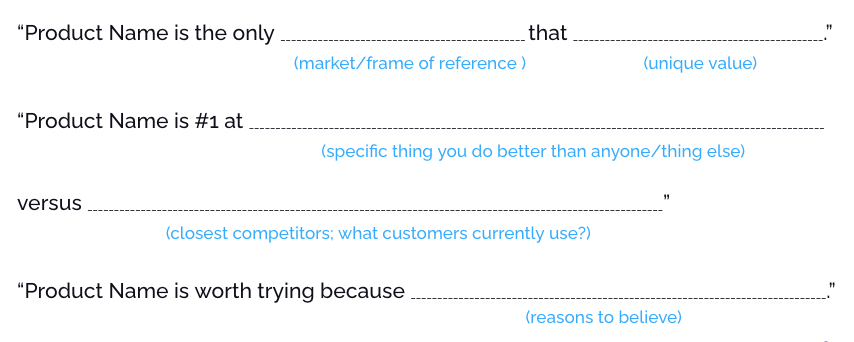
It’s important here to use the language of the customer. Use words they would use, reference points they have. Most customers won’t understand the shorthand you use internally or the jargon used more broadly in the tech world.
This is another generative exercise, you won’t use this exact language in your external messaging. Rather, this exercise is meant to help you construct the right scaffolding for your messaging.
Positioning Next Steps
[ ] Create your own positioning framework using the template and exercises above. Think of this as your MVP – minimum viable positioning.
[ ] Use your MVP to develop or update your sales pitch and story.
[ ] Develop a concise messaging document that builds upon the positioning framework.
[ ] Share your MVP and messaging document with the broader team and other 3rd-party collaborators, so everyone is on the same page.
[ ] Use the MVP to pressure test your product roadmap and pricing strategy.
[ ] Connect with other founders on the Ritual Slack #marketing channel.
[ ] Reach out to Jamie for specific questions or feedback.
[ ] Book a brand sprint with Jamie.
[ ] Make positioning a ritual. Re-evaluate your positioning (roughly) every 6 months and iterate based on what you are hearing from customers.
Positioning Resources
Positioning: The Battle for Your Mind by Al Ries and Jack Trout – This is the classic academic take on positioning. It’s a fascinating read if you want to understand the psychology behind this craft from the marketing strategists who originated the concept in the business world.
Obviously Awesome by April Dunford – This is a more current take on positioning from someone who better understands the B2B tech landscape. The approach is more appropriate for companies a bit further along who are launching new products, but there’s a lot to learn (and steal) from April’s thinking.