
Caladan Bio: Building the Infrastructure for Programmable Biology
Biology has gotten dramatically better at designing what might work. Scientists can engineer cells, proteins, enzymes, and organisms with a level of precision that would have seemed impossible a generation ago. But turning those designs into products still requires an enormous amount of physical experimentation. Researchers run fermentation processes, adjust conditions, measure what happened, and repeat, often hundreds or thousands of times before a process is ready to scale.
That experimental layer remains surprisingly manual, expensive, and fragmented.
Caladan Bio is building a new foundation for it.
Turning Experiments Into Infrastructure
Caladan started with one of the most important pieces of equipment in a bioprocessing lab: the bioreactor. Its Caladan 250 is a modular benchtop system designed to let scientists run many experiments in parallel while continuously capturing what happens inside each vessel. Sensors, automation, experiment controls, and software are integrated into a single platform, giving researchers a richer and more consistent view of the biological process as it unfolds.
There is an immediate practical benefit. Bioprocess teams can run experiments more efficiently, automate work that traditionally requires substantial human intervention, and generate better data along the way.
But the more interesting opportunity sits one layer above the hardware.
Every experiment produces information about how a biological system responds to different inputs. Change the temperature, nutrient mix, oxygen level, feeding schedule, or hundreds of other variables and the organism responds. Historically, much of that information has been trapped inside individual pieces of equipment, spreadsheets, or the heads of scientists.
Caladan is turning those experiments into structured data.
CaladanOS sits alongside the hardware as the control layer and system of record, allowing experiments to be designed, monitored, repeated, and analyzed within the same environment. Over time, that creates the possibility of a much tighter loop between experimentation and computation: run an experiment, capture the result, learn from it, and use that knowledge to determine what should happen next.
That starts to look less like laboratory equipment and more like infrastructure for programmable biology.
A Team Built for the Problem
Building that system requires an unusual combination of disciplines. You need to understand mechanical engineering, automation, software, sensors, manufacturing, and the realities of how scientists actually work in the lab.
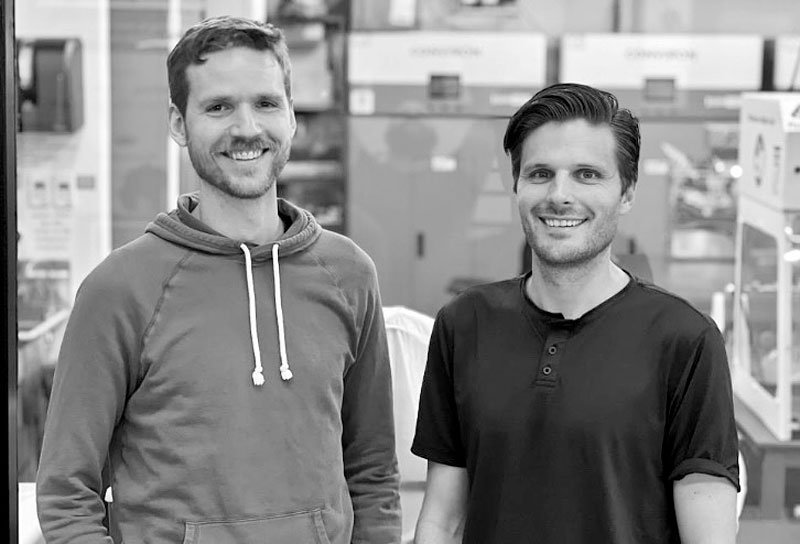
That combination is what originally drew us to founders Mike Kobida and Rob Jauquet.
Mike and Rob met while studying at the University of Wisconsin-Madison and spent their careers building products across the physical and digital worlds before starting Caladan in 2023. Mike worked at companies including MakerBot, Peloton, and Opentrons, giving him firsthand experience building sophisticated hardware and automation products, including tools designed specifically for scientists. Rob came from the software side, including time at Zapier, where he worked on systems for automating complex workflows.
Put those backgrounds together and the shape of Caladan makes sense. Mike understands what it takes to build reliable physical products for demanding users. Rob understands how software can turn complicated, multi-step processes into systems that feel simple. Caladan requires both.
Laboratory equipment has historically been dominated by systems that are powerful but expensive, complicated, and slow to evolve. Mike and Rob approach the category with the instincts of a modern product company: integrated hardware and software, thoughtful industrial design, modular systems, and a relentless focus on usability.
They are building tools scientists should actually want to use.
Biology Needs Better Tools
The opportunity extends far beyond any single market in biotechnology.
Biological manufacturing is increasingly being used to create therapeutics, enzymes, food ingredients, chemicals, materials, and entirely new classes of products. Caladan’s customers span many of these areas, but they share the same underlying problem: eventually, every biological design has to prove itself in the physical world.
As computational biology and AI improve, that problem becomes more important. A model can propose thousands of promising possibilities. Researchers still need to determine which ones actually work, under what conditions, and whether those results can be reproduced at larger scale.
The companies that build the infrastructure connecting computation to physical experimentation could occupy a critical position in the next generation of biotechnology. The more experiments that can be run, the more consistently they can be executed, and the more structured the resulting data becomes, the faster biological systems can be understood and improved.
Caladan has the opportunity to become part of that feedback loop.
Why We Invested
When we invested in Caladan, the immediate product was compelling. Bioreactors are essential tools, existing systems leave plenty of room for improvement, and Mike and Rob had exactly the cross-disciplinary background required to rethink the category.
Our conviction has grown around the larger possibility.
The future of biology will require enormous amounts of high-quality experimental data. That data has to come from the physical world, where cells grow, proteins are expressed, fermentation happens, and computational predictions encounter biological reality.
Someone has to build the machines and software that make those experiments programmable. Mike and Rob have spent their careers building the two sides of that system.
Caladan is bringing them together from the lab bench up. If they succeed, the bioreactor is only the beginning.